Hydroseed for Erosion Control on Florida Construction Sites: A GC's Guide
By Editorial Team · February 10, 2026
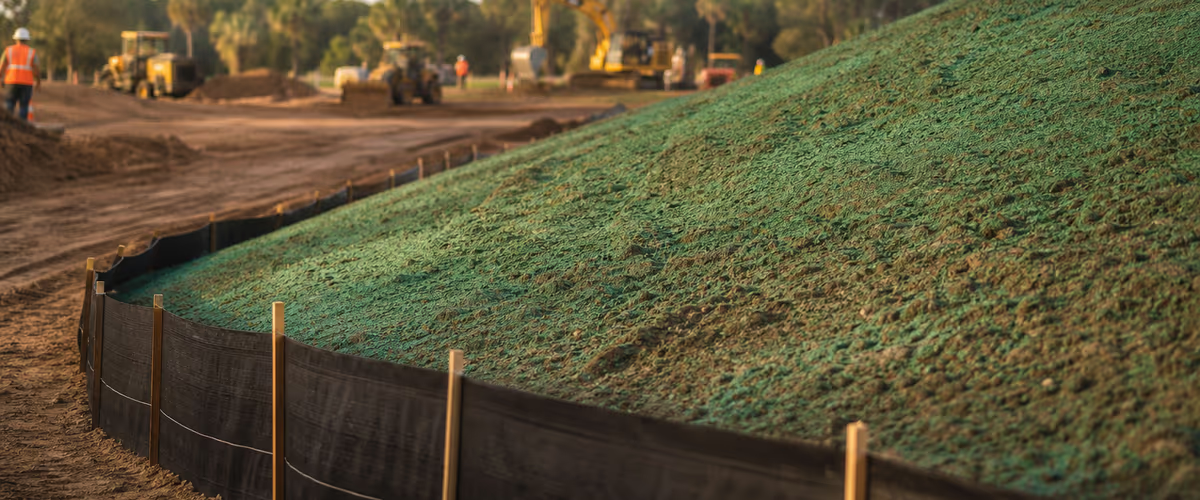
If you’re running a Florida construction site of one acre or more, you need a stabilization plan that survives an inspector visit. Hydroseed is the most cost-effective answer for most projects — but only if it’s specified correctly, applied at the right time, and documented to the standard your inspector expects. This guide is written for GCs, project superintendents, and developers managing the erosion-control side of the build.
What the regulations actually require
Florida construction sites are governed by overlapping erosion-control rules:
NPDES Construction General Permit (CGP)
The federal-EPA-administered Construction General Permit applies to any site disturbing one acre or more (smaller if it’s part of a larger common plan). Key triggers:
- 14-day rule. If active work has stopped on an area for 14 days, that area requires stabilization.
- Final stabilization. Required before the Notice of Termination (NOT) can be filed. Definition varies by permit version but typically means 70%+ uniform vegetative cover or equivalent permanent BMP.
- Inspection logs. Weekly self-inspections and post-storm inspections must be documented and available on-site.
- SWPPP updates. Any change to the stabilization plan needs to be reflected in the Stormwater Pollution Prevention Plan.
FDEP Stormwater Generic Permit
Florida-administered counterpart to the federal CGP, with state-specific provisions:
- Application rate guidance for hydroseed and hydromulch products
- Approved species lists for different regions and habitat types
- Buffer requirements near wetlands and water bodies
County and municipal requirements
Many Florida counties layer their own requirements on top:
- Alachua County: Tight inspection cycles, specific species lists for projects near Newnans Lake and Paynes Prairie buffers.
- Hillsborough County: Detailed pre-construction meeting requirements; inspector availability can drive scheduling.
- Marion County: Limestone-influenced soil considerations for amendment requirements.
- Volusia County: Coastal buffer requirements and FDEP Coastal Construction Control Line considerations.
- Miami-Dade and Broward: South Florida Water Management District overlay on the state permit.
Check with your county’s stormwater coordinator before specifying — local addenda can dictate which slurry products are accepted and what documentation goes into the inspection record.
When to apply hydroseed in the construction sequence
Erosion-control hydroseed is timing-sensitive. Apply too early and subsequent trades destroy the establishing turf; apply too late and you’ve already had 14-day-rule inspection failures. The standard sequence:
- Mass grading complete. Final contours, not still being moved. Topsoil distributed if required by spec.
- Storm system installed. Pipes, structures, inlets in place. Any structure-related grading complete.
- Utilities installed. Water, sewer, gas, electric, communications — the trades that dig trenches.
- Curb and primary hardscape complete. Anything that requires equipment traffic in the seeded area.
- Rough landscape complete. Trees planted, mulch beds defined, any rough landscape grading done.
- Hydroseed apply. With surface lightly raked or scarified for seed-to-soil contact.
- Final landscape and turf. Sodded areas (if any), final mulching, irrigation final.
The biggest scheduling mistake is applying hydroseed before utilities are done. Trenchers, side-loaders, and concrete trucks crossing freshly seeded ground will require re-application.
Product selection by site condition
Three products dominate Florida construction-site erosion control:
| Product | Cost (relative) | Best for | Specifications |
|---|---|---|---|
| Standard hydroseed | Lowest | Flat shoulders, building pads, low-slope swales | Mulch rate typically 1,500–2,500 lb/acre |
| SMM (Stabilized Mulch Matrix) | Middle | Moderate slopes 3:1 to 2:1, pond banks | Mulch + tackifier blend, 3,000–3,500 lb/acre |
| BFM (Bonded Fiber Matrix) | Highest | Steep slopes 2:1+, DOT spec slopes | Crosslinking polymer matrix, 3,500–4,500 lb/acre |
For slopes steeper than 1:1, layer with an erosion control blanket (ECB) or turf reinforcement mat (TRM). For waterbody buffers and direct discharge zones, check the county’s approved BMP list — some require permanent sod or specific native blends rather than hydroseed.
See our BFM vs SMM guide for the technical details on each product.
Documentation that satisfies inspectors
A good erosion-control contractor will hand you a packet for each application that contains:
- Application certificate. Date, area covered (square footage or acres), slurry composition (seed species and rate, mulch type and rate, tackifier, fertilizer), and applicator signature.
- Photo log. Wide shots of the area before and after application, plus close-ups of representative coverage.
- Weather log. Conditions at application (temperature, humidity, wind, recent rainfall).
- Material certifications. Seed tag (varieties, germination rate, purity), mulch and tackifier product data sheets.
- Follow-up inspection. Germination check at day 10–14 with photos.
- Final acceptance documentation. Cover percentage at week 4–6, certifying readiness for inspection sign-off.
Bind this packet with your SWPPP records. When the NPDES inspector arrives, you should be able to hand it over without searching.
Cost framing for construction-site work
Erosion-control hydroseed on construction sites is typically bid by the acre. Per-acre rates depend on:
- Product specified (standard hydroseed < SMM < BFM)
- Slope and access (steeper, harder-to-reach = higher)
- Seed blend (native blends usually cost more than commercial)
- Documentation requirements (DOT spec packages cost more than basic residential subdivision)
- Project size (larger projects = lower per-acre rate)
For multi-acre commercial projects, expect per-square-foot rates significantly below the residential range. Get itemized scope from each bidder so you can compare apples to apples.
Common failure modes that trigger re-inspection
- Insufficient mulch rate on slopes. The contractor used a standard residential rate on a slope that needed SMM or BFM. First heavy rain washes the surface and the inspector flags it.
- Wrong species mix. Generic warm-season blend on a project that required FDEP-approved native blend. Inspector rejects the species composition.
- Application before grading was final. Subsequent grading buried or stripped the application. Re-spray required.
- Inadequate watering during establishment. Especially on remote DOT projects with no permanent irrigation. Bare patches don’t reach the 70% cover threshold by inspection deadline.
- Documentation gaps. Application was fine but the paperwork was incomplete. Inspector can’t sign off without the packet.
- Equipment traffic after application. Subcontractors driving across the establishing turf. Aggressive site management required.
Phasing tips for multi-phase projects
Large projects (subdivisions, business parks) often stabilize in phases as different areas become inactive. A few rules:
- Don’t try to “save” stabilization by holding off until the very end. The 14-day rule will catch you.
- Map the construction phasing first. Identify which areas will go quiet 30 days from now, 60 days, 90 days. That’s your hydroseed schedule.
- Use temporary stabilization for areas that will see disturbance again soon. Annual rye, oats, or a mulch-only application is cheaper than full hydroseed when you know it’s getting torn up later.
- Final pass at the very end for permanent stabilization. Plan this 60–90 days before NOT filing.
Get a quote with full documentation included
For a hydroseed quote with NPDES-compliant documentation, slope-specific slurry, and an inspection-ready packet, request a free estimate and we’ll match you with a Florida contractor experienced in commercial erosion-control work.