Hydroseeding in Tallahassee, FL
Hydroseeding, erosion control, and lawn establishment services for Tallahassee, FL property owners. Tallahassee's rolling topography (unusual for Florida) and red-clay subsoil make it one of the strongest erosion-control
About hydroseeding in Tallahassee
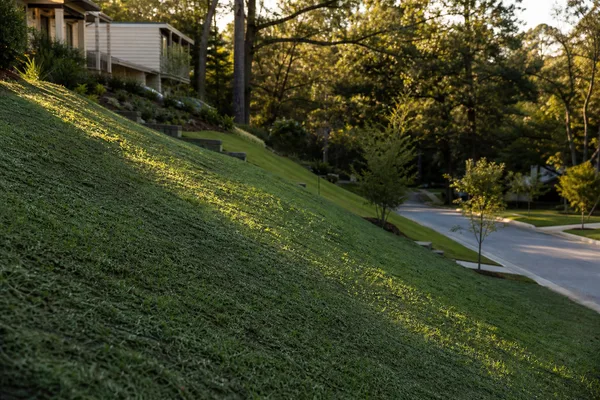
Tallahassee's rolling topography (unusual for Florida) and red-clay subsoil make it one of the strongest erosion-control hydroseed markets in the state. Slope-stabilization work is routine on residential lots in the hills north of I-10 and on FDOT projects throughout Leon County. Soil acidity here often requires lime amendments alongside the slurry application.
Local soil and climate
Tallahassee is geographically and geologically distinct from peninsular Florida. The terrain rolls — actual hills with measurable slope, particularly through the Northern Highlands area north of I-10 — and the soils carry significant clay content, including the characteristic red-clay subsoil visible in road cuts throughout Leon County. Soil pH runs more acidic than peninsular Florida, often in the 5.0–5.8 range, which calls for lime amendment before hydroseed application on most projects targeting healthy turf establishment.
Climate is humid subtropical with a more pronounced winter than the rest of Florida. Hard freezes are reliable events most winters — sometimes multiple consecutive nights below 30°F in December and January. This affects species selection: cold-tolerant varieties like Pensacola Bahia outperform Bermuda for permanent stabilization in exposed Panhandle conditions. Summer rainfall is heavy, particularly along the Gulf-influenced coastal plain south of the city.
Slope-stabilization projects and erosion control
Tallahassee’s combination of rolling terrain, clay soils, and heavy summer rainfall makes it one of Florida’s most active markets for erosion-control hydroseed and engineered hydromulch:
- FDOT roadway projects. Florida Department of Transportation work in Leon and surrounding counties frequently specifies SMM or BFM products for cut-and-fill slopes on I-10, US-90, and arterial corridors.
- Residential slope work. New construction in the rolling hills north of I-10 (Killearn Estates, Bull Run, Summerbrooke) often involves significant cut slopes that need professional stabilization.
- Pond bank construction. Stormwater retention and detention ponds for commercial and residential development require permanent vegetative stabilization on banks.
- Post-construction restoration. Government buildings, university grounds (FSU, FAMU, TCC), and commercial sites where grading exposed soils that need permanent stabilization.
For residential slope work in the Tallahassee area, ratios commonly run 3:1 to 2:1 on cut banks — slopes that often require SMM-class hydromulch rather than standard hydroseed. See our slope and BFM guide for the technical decision framework.
Common seed blends and amendment considerations
The Panhandle’s longer winters and clay soils favor cold-tolerant, acid-tolerant species:
- Pensacola Bahia — the regional default for residential and roadside work. Excellent cold tolerance, tolerates the clay-influenced acidic soils, deep roots for slope work.
- Argentine Bahia — a darker, coarser variant common in residential applications where appearance matters more than cold-hardiness.
- Common Bermuda — used on full-sun residential lawns in protected microclimates (south-facing exposures) but susceptible to winter damage in exposed Panhandle conditions.
- Centipede — increasingly popular in Tallahassee suburbs for its acid-soil tolerance and low maintenance requirements.
Lime amendment is included in most quality Tallahassee hydroseed quotes because of the acidic soil pH. A reputable contractor will soil-test the project before specifying the slurry composition and either include lime application or recommend it as a separate pass before seeding.
Common project profiles in the Tallahassee market
- Residential lots in Killearn, Summerbrooke, and northeast Tallahassee. Larger lots, frequent slope work, established neighborhoods that periodically renovate.
- FDOT and county roadway erosion control. Continuous work on state and county roadway projects throughout the Big Bend area.
- University grounds. FSU, FAMU, and TCC periodically renovate athletic and ornamental grounds.
- Wakulla and Jefferson County rural work. Pasture establishment, large-acreage residential, and timber-conversion projects in the surrounding counties.
Water management and HOA considerations
Tallahassee falls within the Northwest Florida Water Management District (NWFWMD), which has historically had less restrictive watering schedules than peninsular Florida — typically two days per week with hours-of-day restrictions. Newly established lawns get a temporary exemption.
Killearn, Summerbrooke, and Bull Run HOAs generally have standard landscape requirements; commercial properties along Apalachee Parkway and the Capital Circle corridor follow standard commercial landscape codes.
Request a Tallahassee-area quote
For a Tallahassee-area hydroseed quote with clay-soil amendment recommendations, slope-aware slurry selection, and Panhandle-climate-appropriate species, request a free estimate.
Nearby areas served
- Crawfordville
- Quincy
- Monticello
- Havana
- Woodville