Erosion Control & Slope Stabilization
Engineered hydroseed and hydromulch applications for banks, hillsides, highway shoulders, and construction zones — fast soil lockdown with environmental compliance.
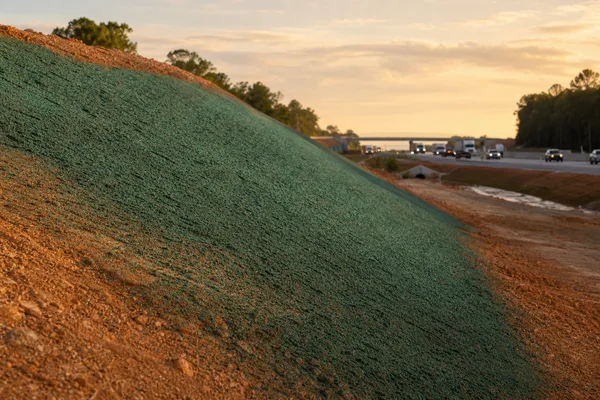
BFM (Bonded Fiber Matrix) and SMM (Stabilized Mulch Matrix) options
Meets NPDES, FDEP, and county stormwater requirements
Locks down bare soil within hours of application
Combines vegetation establishment with immediate erosion protection
Erosion control is where hydroseeding stops being a lawn-care choice and starts being engineering. On a graded slope without vegetative cover, a single Florida thunderstorm can dump tons of topsoil into a downstream pond, choke a culvert, or trigger a stop-work order from an inspector. Hydroseed and engineered hydromulch products are the industry-standard answer because they lock the soil surface within hours of application and establish permanent vegetative cover within weeks.
When you need it
Common triggers for an erosion-control hydroseed call:
- NPDES Construction General Permit compliance. Any site disturbing one acre or more requires temporary or permanent stabilization on areas where active work has stopped for 14 days or more.
- FDEP and county stormwater inspections. Florida counties enforce erosion-control Best Management Practices on permitted projects — non-compliance means fines, re-inspection delays, and certificate-of-occupancy holds.
- DOT roadway projects. FDOT Section 570 specifies grassing requirements for shoulders, slopes, and median strips on state roadway work.
- Pond and stormwater system construction. Retention and detention basin slopes are particularly vulnerable until established vegetation takes hold.
- Residential slope work. Steep yard slopes after grading, retaining-wall backfills, or storm damage repair.
Decision matrix: standard hydroseed vs SMM vs BFM
The slurry composition needs to match the slope angle and rainfall risk. Three products dominate Florida erosion-control work:
| Product | Best slope range | Rain resistance | When to specify |
|---|---|---|---|
| Standard hydroseed | Flatter than 3:1 (33%) | Light to moderate rain after 1 hour | Lawns, low-slope shoulders, pond perimeter |
| SMM (Stabilized Mulch Matrix) | 3:1 to 2:1 (33–50%) | Moderate rain, won’t survive a downpour | Moderate slopes, residential bank stabilization |
| BFM (Bonded Fiber Matrix) | 2:1 to 1:1 (50–100%) | Cures into a rain-resistant mat | DOT slopes, steep residential cuts, post-grading hillsides |
BFM uses crosslinking polymers that cure into a continuous, rain-resistant mat 12–24 hours after application. It costs more per acre than SMM or standard hydroseed but is required by spec on most steep DOT and pond-bank work. See our slopes and BFM technical guide for a deeper look at when each product makes sense.
For slopes steeper than 1:1, hydroseed alone usually isn’t enough — those projects typically combine an erosion control blanket (ECB) or turf reinforcement mat (TRM) with hydroseed underneath to give the seedlings something to anchor into.
NPDES and FDEP compliance basics
Erosion-control hydroseed work on permitted Florida sites generates paperwork that the GC or owner-builder needs to file. Standard documentation captures:
- Application date and area by square footage or acres
- Slurry composition — seed mix, mulch type, tackifier, fertilizer rate
- Soil moisture and weather at application
- Inspector contact and follow-up germination check schedule
- Photographs showing pre- and post-application surface condition
Most county inspectors want to see established vegetative cover (typically 70% uniform coverage) before they sign off on permanent stabilization. The germination window is 5–10 days in Florida’s growing season, with full coverage by week 4–6 under normal conditions.
Phasing with grading and construction
The single biggest scheduling mistake on erosion-control projects is applying hydroseed before construction work in adjacent areas is complete. Common phasing:
- Rough grading complete in the area to be stabilized — final contours, not still being adjusted.
- Adjacent trades cleared — utilities, curb, drainage installed and tested.
- Surface lightly raked to break any crust and provide seed-to-soil contact.
- Hydroseed or hydromulch applied with appropriate slurry for the slope angle.
- Maintained until established — supplementary watering if the climate is dry, monitoring for washouts.
- Inspection sign-off typically at 70%+ uniform coverage.
Re-applying because subsequent trades damaged establishing vegetation is the most expensive mistake in this workflow. Build the phasing into the construction schedule from day one.
Native and adapted seed mixes for Florida slopes
For permanent stabilization in Florida, common species selections include:
- Argentine Bahiagrass — deep roots, drought-tolerant, the workhorse of Florida roadside stabilization.
- Pensacola Bahiagrass — finer-textured Bahia variant with similar erosion-control performance.
- Common Bermuda — fast germination, dense cover, good for shoulders and flat slopes.
- Native blends — wiregrass, lopsided indiangrass, and other Florida natives for ecologically-sensitive areas.
- Annual ryegrass nurse crop — added to warm-season blends for cooler-month winter cover while permanent species establish.
Slope work in interior North Florida sometimes needs lime amendment to address soil acidity — your contractor should soil-test before specifying the mix.
Get a quote with your specs attached
Erosion-control bids are tighter when the contractor knows the slope %, soil type, water access, and required inspection documentation up front. Request a free estimate with your grading plan and project specs.