Hydroseeding vs Sod in Florida: Cost Comparison Per Square Foot
By Editorial Team · January 15, 2026
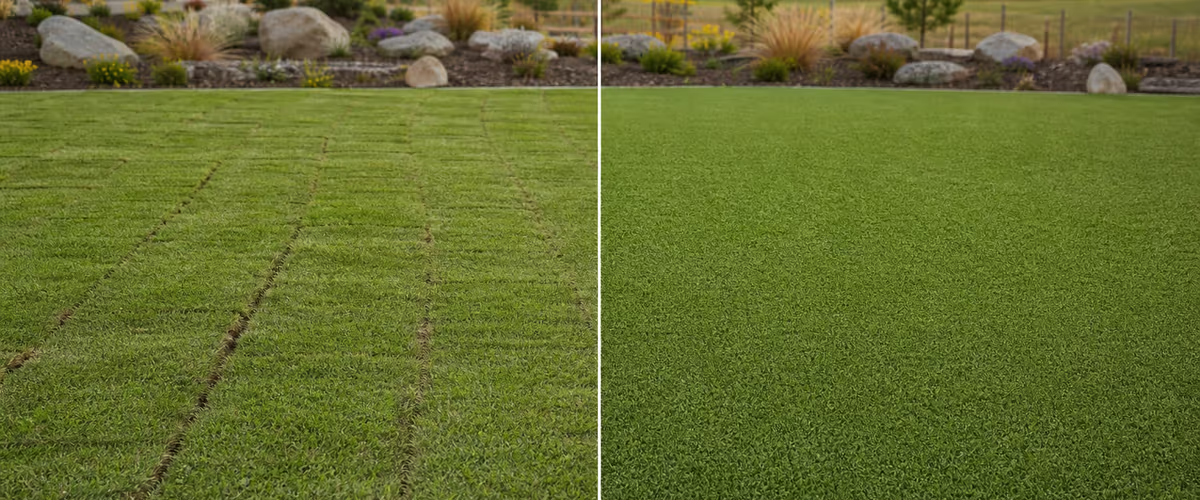
For Florida property owners weighing hydroseeding against traditional sod installation, the question almost always comes down to one number — cost per square foot. Both methods produce established turf, but the price difference is significant enough that it usually drives the decision. This guide compares average market rates for sod and hydroseeding in Florida, what each price typically includes, and where the gap comes from.
Hydroseeding cost per square foot
Hydroseeding in Florida typically falls in the $0.15 to $0.30 per square foot range for residential and small commercial projects. The specific number within that range depends on:
- Seed blend. Common warm-season grasses (Bermuda, Bahia, Centipede) sit at the lower end of the range. Zoysia and custom blends sit at the higher end.
- Slurry composition. A reputable contractor’s mix includes seed, wood or paper fiber mulch, tackifier, and starter fertilizer. Slurries without tackifier or fertilizer cost less but underperform — verify what’s included before comparing two quotes.
- Site access and prep. Sloped, debris-heavy, or hard-to-reach properties take longer to apply and cost more per square foot.
- Project size. Larger areas dilute the fixed cost of mobilizing the equipment and bring the per-square-foot rate down.
What’s typically included at the standard rate: site assessment, light surface raking, mixing and applying the slurry, and a follow-up check during the first week. Heavy debris removal, fine grading, irrigation system work, and soil amendments are usually quoted separately.
Sod installation cost per square foot
Installed sod in Florida averages roughly $0.50 to $1.50 per square foot, depending on grass type, project size, and how much site prep is required. A typical breakdown:
- Sod material alone: $0.30 to $0.80 per square foot delivered to the property, before labor.
- Labor and installation: another $0.20 to $0.70 per square foot.
- Premium varieties (St. Augustine Floratam, Empire Zoysia, Celebration Bermuda) push toward the high end of both ranges.
- Common varieties (Bahia, basic Bermuda) sit toward the low end.
Sod pricing is heavily weighted toward two things hydroseeding doesn’t have: harvesting and transportation. The grass was grown on a sod farm somewhere else, cut into rolls or pallets on the day of delivery (it can’t sit), trucked to your property, and laid down by hand. All of that is built into the installed price.
Side-by-side at a glance
| Cost factor | Hydroseeding | Sod (installed) |
|---|---|---|
| Average per square foot | $0.15 – $0.30 | $0.50 – $1.50 |
| Day-1 appearance | Green-tinted slurry | Finished lawn |
| Time to first germination | 5–10 days | Already established |
| Time to fully usable lawn | 4–6 weeks | 2–3 weeks (root knit) |
| Suitable for steep slopes | Yes (specialty mixes) | No (slides) |
| Practical minimum project size | ~2,000 sq ft | None |
The per-square-foot gap typically lands somewhere between roughly 3× and 5× cheaper for hydroseed, depending on which end of each range applies to your project.
Why the price gap exists
It’s not that hydroseeding is suspiciously cheap or that sod is overpriced — they’re priced differently because they’re different products.
Sod is a finished agricultural good. A sod farm grows the grass for a year or more, then harvests it on demand. The price reflects the land, water, time, harvesting equipment, refrigerated transport, and the physical labor of placing rolls or pallets piece by piece.
Hydroseed is a custom slurry sprayed in place. The contractor mixes seed, mulch, tackifier, and starter fertilizer in a tank-mounted unit and applies it directly to your prepped soil. Material costs per square foot are lower (seed by weight is cheaper than mature grass by weight), and a single operator with a hose can cover ground much faster than a sod-laying crew.
The trade-off is time: hydroseed needs four to six weeks of careful watering before you have a usable lawn. Sod looks finished the day it’s installed. Both methods produce comparable lawns at the one-year mark, with hydroseed often developing slightly deeper roots because the grass grew in place rather than being transplanted.
Where the ranges come from
Within each method, the actual quote you get depends on a few consistent factors:
Project size. Mobilizing a hydroseed truck has a fixed cost regardless of the job. A 2,000 sq ft yard tends to quote at the high end of the range; a 20,000 sq ft yard at the low end. Sod scales more linearly because labor is the dominant cost.
Grass species. Common warm-season grasses cost less than premium cultivars in both sod and hydroseed form. If a contractor offers a “starting at” price, it’s almost always for the cheapest common blend.
Site prep. A flat, debris-free yard ready for application costs less than a recently graded lot with rocks, construction debris, or compacted soil that needs amendment. This applies to both methods.
Regional variation. Pricing in the Florida Panhandle is sometimes different from Central or South Florida due to local labor markets, fuel costs, and seed availability — but the relative gap between hydroseed and sod is similar statewide.
When sod still makes sense despite the cost
The price gap is real, but cost isn’t the only factor. Sod still wins when:
- You need the lawn finished now. Selling a house, hosting an event, or facing an HOA deadline — sod gives you a usable lawn in days, not weeks.
- Small repair patches. For under 1,000 sq ft, sod material at a garden center is often the practical choice — mobilizing a hydroseed truck for that little area isn’t economical.
- High traffic during establishment. Hydroseeded lawns need three to four weeks of light foot traffic. Sod can handle light traffic almost immediately.
- Heavy pet use planned soon. Same reason — establishment time matters when the lawn won’t be left undisturbed.
For everything else — new construction, large yards, slope work, budget-sensitive projects, and most erosion control jobs — hydroseed’s cost advantage usually outweighs the wait. See our residential lawn seeding service and erosion control service for what each looks like on a real project.
Verify pricing for your specific project
The ranges above are typical for Florida at the time of writing. They are not a substitute for a real quote on your property — material costs fluctuate, regional pricing varies, and the “what’s included” line item differs between contractors.
A useful exercise: get two quotes from different contractors for the same project scope, one quoting hydroseed and one quoting sod. The variation between contractors will tell you more about your specific project than any published average.
If you’d like a hydroseed quote for your Florida property, request a free estimate and we’ll match you with a vetted local pro who’ll review your site and respond within one business day.