Commercial Seeding & Development
High-volume hydroseeding for subdivisions, business parks, athletic fields, and large-scale development projects across Florida.
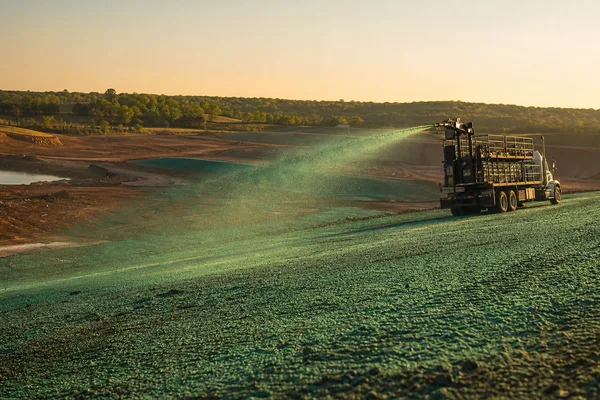
Crews and equipment sized for multi-acre application in a single day
Specifications matched to municipal, DOT, and county requirements
Reduced per-acre cost versus sod or sprig planting
Documentation packets for inspection sign-off
Commercial hydroseeding is what made the technique a default specification for transportation departments and large developers in the first place. At the scale of subdivisions, business parks, and DOT shoulders, the cost gap between hydroseed and sod becomes enormous — and the logistics of mobilizing hundreds of sod pallets simply don’t work.
Project profiles we typically see
- Residential subdivision common areas. HOA lawns, retention pond banks, entry features, and amenity-area turf for new developments.
- Commercial site landscaping. Business parks, retail outparcels, hotel grounds, multi-family complexes, and self-storage facilities post-construction.
- Municipal and DOT specifications. Highway shoulders, interchange slopes, roadside revegetation, and county-permitted erosion-control work.
- Athletic and recreation fields. Football, soccer, baseball, and multi-use fields at schools, parks, and private athletic clubs. See our athletic field seeding service for sport-specific blends.
- Industrial site reclamation. Post-grading restoration on warehouse pads, distribution centers, and utility sites.
Equipment scales with project size — small commercial jobs use trailer-mounted tanks in the 500–1,000 gallon range, while multi-acre projects bring in truck-mounted units with 3,000+ gallon capacity, onboard mechanical agitation, and tower nozzles that reach 100+ feet without repositioning.
Documentation and compliance
For projects that touch public right-of-way, stormwater systems, or environmental permits, the paperwork side of the job is almost as important as the application itself. Standard documentation typically includes:
- NPDES Construction General Permit compliance. Hydroseeding is one of the EPA-accepted stabilization Best Management Practices (BMPs) for sites disturbing one acre or more. Inspection logs need to reference application date, area covered, and slurry composition.
- FDEP Stormwater specifications. Florida Department of Environmental Protection guidance on temporary and permanent vegetative stabilization, slope-specific application rates, and species selection for buffer zones.
- County / municipal specs. Many Florida counties have their own erosion-control checklists — Marion, Alachua, Hillsborough, and Volusia each have nuances on inspection timing and species lists.
- DOT specifications. FDOT Section 570 governs grassing on state roadway projects, including specifications for hydroseed mix ratios, fertilizer rates, and inspection acceptance criteria.
A reputable contractor will hand the GC or project manager a packet with application date, location, area covered, mix used, rate, and a follow-up germination check — everything the county inspector needs to sign off the BMP.
Lead time and scheduling
For most Florida commercial work, expect:
- Quote turnaround: 3–5 business days from site walk to written bid for a defined scope.
- Mobilization window: 1–3 weeks from contract signing to application, depending on contractor backlog and weather.
- Sequencing: Hydroseed is typically the last step before final inspection. It needs to follow grading, utility installation, and any rough landscape work. Trying to phase it earlier almost always means re-application after subsequent trades damage the establishing turf.
- Weather sensitivity: Tropical activity, sustained rain, or extended cold snaps can push applications by days to weeks. Plan around the Atlantic and Gulf hurricane forecasts in late summer and early fall.
What to send for a competitive bid
The fastest way to get an accurate commercial quote is to send:
- Total area in square feet or acres, broken down by use case (flat lawn vs slope vs erosion-only)
- Site plan or grading plan showing slopes, drainage, and access points
- Project specs if there are any municipal, DOT, or environmental requirements
- Tentative schedule — when will grading be complete, what’s the deadline for stabilization
- Water source — is there a permanent water meter available, or does the contractor need to truck in water for establishment
The more of this you can hand to the bidder upfront, the tighter and more comparable the bids will be.
Cost framing for commercial work
Commercial hydroseeding is typically bid per acre rather than per square foot, with the per-acre rate influenced by total area, slope percentage, soil type, water access, and required slurry specifications (Bonded Fiber Matrix vs Stabilized Mulch Matrix vs standard hydroseed — see our BFM vs standard hydroseed guide). Per-square-foot rates on commercial work generally come in below the residential range because of scale efficiencies.
For an accurate quote, request a free estimate with your project specs attached.